Concept Art Zak Mckracken Map Indiana Jonesfate of Atlantis
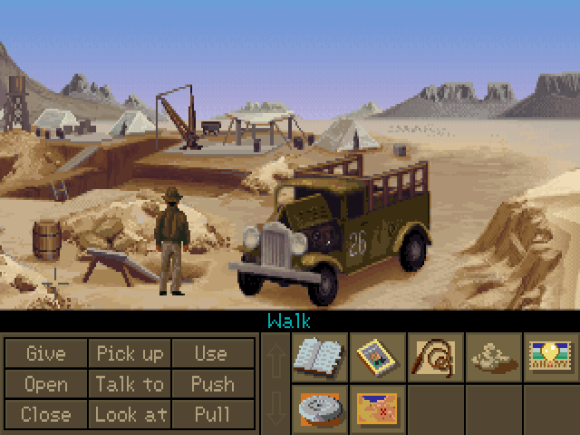
Indiana Jones And The Fate Of Atlantis is 2nd on the list of games I was nearly looking forward to playing for the first time as office of this series. Unlike most of the other games on that list it'south only ever referred to as a stone-common cold classic — both at the time and by anyone you lot ask near information technology today — and I also quite liked Indiana Jones And The Terminal Cause despite that game being comparatively clunky and obtuse by modern standards. The concept of an Indiana Jones take a chance game conspicuously has legs, and I was excited to play something wholly original that wasn't shackled to a flick script, and which had been developed during LucasArts' true golden age.
Imagine my surprise, then, to discover that, contrary to everything I'd heard about it over the last quarter-century, Indiana Jones And The Fate Of Atlantis fucking sucks.
Oh, it's not without a few interesting ideas that aggrandize on the multiple-routes idea pioneered by Last Crusade, but brand no mistake: Fate Of Atlantis is a terrible adventure game which reminded me of cypher more than Zak McKracken in a fresher glaze of paint. It has the aforementioned depressing tendency to revert to Hazard Game Logic when solving puzzles, the same misguided conventionalities that having the player blunder around in a pitch-black room for twenty minutes counts as interesting gameplay, and the same utterly inexplicable love of mazes. That last item is taken to the point of absurdity hither, since practically the entire back one-half of the game is nothing more than than a serial of mazes with a few substandard, illogical puzzles scattered inside of them. I very nearly didn't make information technology to the end of Fate Of Atlantis, even with a walkthrough, because the process of going through maze after maze after maze was slowly sapping my will to live. LucasArts had released two Monkey Island games past this bespeak! They know better ways of making adventure games now! Hell, the team responsible for Fate is the same team responsible for Final Crusade, which did a lot of this stuff (especially mazes) in a far more bearable mode and would have been quite easy to spin into a respectable gamble game with updated graphics and "modernistic" conveniences. What on earth made them recall they should become backwards in time and double down on all of the genre'southward well-nigh insufferable vices?
Fate Of Atlantis at least starts adequately promisingly. You go the classic Indiana Jones championship card, and so a cute little introduction sequence where Indy bursts into a storeroom on a search for an ancient artifact and pratfalls his mode from screen to screen while the opening credits play. Just await, what'due south this?
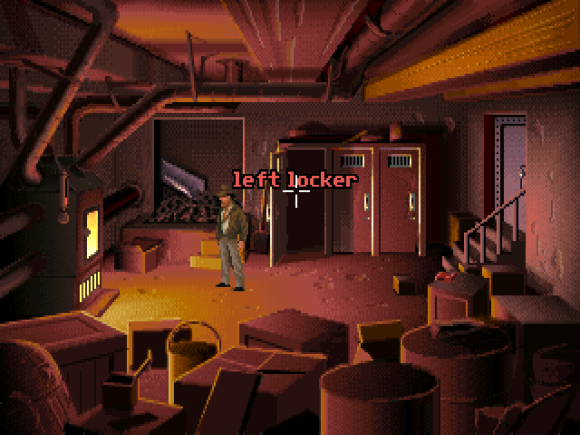
Where is the familiar list of action verbs? Where is my inventory? The intro to Fate doesn't have either, instead plumping for full screen backgrounds and an actual, honest-to-god tooltip that pops upward next to the mouse cursor when you lot hover over something interesting. Clicking on the thing causes Indy to either make an ascertainment about the affair or attempt to collaborate with it. I was initially very dislocated by this, because it appeared that Fate Of Atlantis had come up up with the adjacent big spring in gamble game interfaces a yr or two early1: ditching the on-screen interface and instead implementing context-sensitive mouse controls. The reason I was confused is because I had at least seen screenshots of Fate in gaming magazines at the fourth dimension, and I definitely remembered it having some kind of interface, and I briefly wondered whether or non I was playing some subsequently rerelease that overhauled it out of the game.
I needn't take worried, though; there is only one version of Fate Of Atlantis, and information technology's the ane composed of pure 100% certified A-class shit. (They did add some incredibly bad voice acting in the at present-obligatory CD rerelease a year afterward, but I turned it off inside x minutes of starting the game and the versions are otherwise identical.) A more traditional take chances game interface appears the moment the opening credits are washed, and information technology is spectacularly ugly with none of the amuse of Monkey Island 2's take on the concept; I know that information technology was the style at the time for most computer-related things to be beige, but there's no reason Fate's inventory and buttons accept to be as well. The intro scenes themselves are strikingly lit, leveraging some of what was learned over the last three years, but subsequent locations are… not badly fatigued, as such, they're just a bit generic in style; dissimilar Monkey Island 2, Fate's backgrounds are manifestly art for a videogame, rather than art that has been transplanted into a videogame. If y'all slapped a background from Fate Of Atlantis next to a background from (to pick a random contemporary example) Shadow Of The Comet, I think I'd struggle to tell you which one was which. Later playing Concluding Crusade information technology was squeamish to control an Indy who wasn't composed of flat colour blocks and had a bit more detail to him, but at the same time that detail is somehow indistinct — there's a lot of light and shade applied to a by and large Indy-shaped silhouette, simply non much in the way of recognisable features.
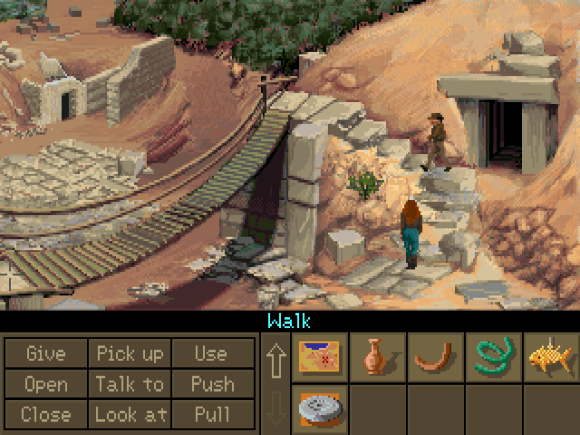
And that'due south the problem with the art in full general: it might never look less than okay, but it has a serious readability issue when trying to pick out actually important detail from the background art. I could mouse over a scene once, twice, three times and not actually observe the of import item that's present because it'southward blending in then well with the groundwork scenery. This is a running thread throughout the unabridged game, starting from the library at Barnett College, running through Tikal and Algiers, Crete, and so finally into Atlantis itself; in all of these locations I missed critical items non because I hadn't spent enough time inspecting the location — this is the seventh LucasArts adventure game I've played and so far and I've gotten quite good at it — simply because it was and then difficult to see them against the fuzzy backgrounds. It doesn't aid that Fate Of Atlantis has also inherited Last Crusade's obsession with pixel hunting; here at least the objects you're hunting for are three pixels big instead of one, but when you make them that pocket-sized it'southward no wonder they go missed even by a reasonably on-the-ball histrion such as myself.
Puzzle-wise Fate Of Atlantis does try something interesting. A mutual criticism of adventure games around this time was that they had zero replayability: you'd play the game once, and then there'd be no point playing it again considering you knew the solution now and it'd play out the aforementioned manner every fourth dimension. This is why and so many of the early LucasArts games comprise features such every bit character switching and randomised puzzle elements, and it's why Last Crusade likewise tried out the idea of alternate routes through the game — steal the biplane or lath the zeppelin, fight the big guard or get him drunk, and so on. The thought was that the game would rail your score across multiple playthroughs, and just by exploring every possible path would yous exist able to achieve maximum points. Fate Of Atlantis does the same thing, simply in a much more structured way; the game'southward plot is a fairly standard race against time to discover Atlantis before the Nazis do (if I were feeling particularly uncharitable I'd call information technology a direct rip-off of Raiders Of The Lost Ark), and Indy hooks up with a bogus psychic called Sophia Hapgood who has a connection to Atlantis. Sophia follows Indy around during the early on function of the game; she isn't a direct controllable character only can exist talked to in order to get hints on where to become side by side or to create distractions. After the outset few locations are out of the way she gives Indy a choice under the guise of telling his fortune.
- Ditch Sophia in New York and continue solo, with an accent on puzzles.
- Ditch Sophia in New York and continue solo, with an emphasis on the returning boxing minigame.
- Let Sophia accompany you lot and continue to employ teamwork to solve puzzles.
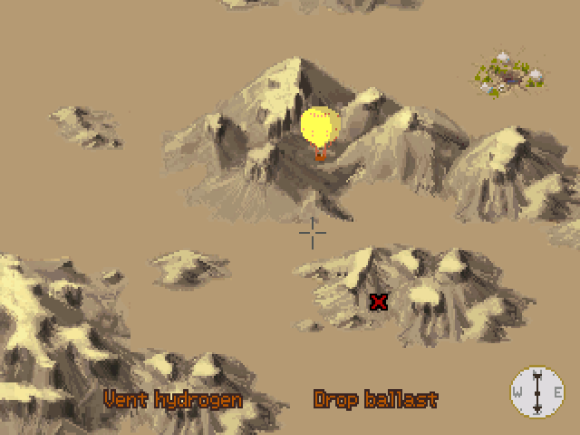
Each option changes how the middle portion of the game progresses; Indy will visit Monte Carlo, Algiers and Crete regardless, merely the specifics of how each location plays out depends on which path he took, where he reaches the Algiers dig site on a camel if you choose the Wits path, but has to steal a balloon instead if you choose Teamwork. The puzzles solved with Sophia present are quite significantly dissimilar than those solved without her, and if you choose Fists you lot always have the option of punching Nazis in lieu of solving the harder ones. The Indy Quotient scoring system also returns, and only past playing all iii paths can you lot max out your score.
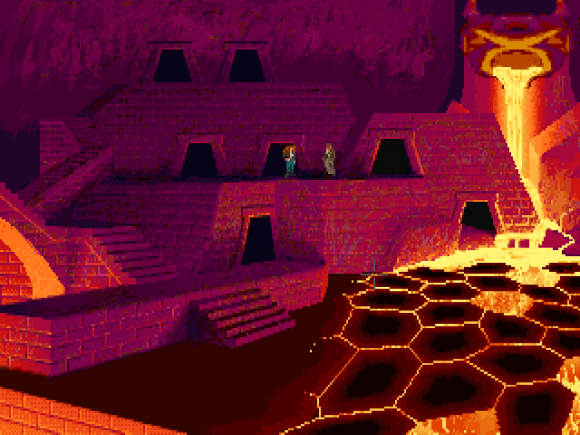
On the face up of it this is all quite welcome, simply information technology'south a program with one tiny flaw: the end of each road, in Atlantis, is exactly the same (Sophia gets kidnapped past the Nazis and transported there if you lot didn't bring her with you), and this is by far the most tedious role of the game. The get-go segment of Atlantis is a big, height-down circular maze carve up into four chunks, with each clamper having 4-5 rooms in it. The locations of the rooms are randomised on each playthrough, and yous accept to visit them in a specific order — you need an insulated loving cup from the statue room so that y'all can fill information technology with lava in the lava room and so that you can pour the lava into the machine in the automobile room — which ways at least two trips around the maze, i to find out where everything is and another to really practise the things you need to do. So there's some incredibly awful backtracking, where yous demand to bring a collection of items from the maze through five screens' worth of canals (hope you didn't miss any of them!) and so that you can employ them to break downward a door into the inner section of Atlantis. This too knocks a hinge pin loose, and if y'all want to save Sophia you have to go back out through the canals and into the dungeon and then that y'all tin employ the hinge pin to free her. A big affair Fate Of Atlantis likes to practise is repeatedly utilize the same item over and over over again to bypass an obstacle, but with no hints given that you're supposed to selection the particular up again after the first fourth dimension y'all've used it; after you've freed Sophia the swivel pivot is stuck in place propping up a door, so I left it backside and went forwards again through those five screens' worth of canals plus some other three screens' worth of corridors but to find that I needed to insert a lever-similar object into an ancient digging machine, a lever-like object much like… that hinge pin. And then back I went for information technology through eight screens' worth of wasted fourth dimension and and so once more on the return trip, where Monkey Island would have just had your character automatically pick the swivel pivot upwards when I tried to leave the room for the first fourth dimension and saved me from all of this boring backtracking.
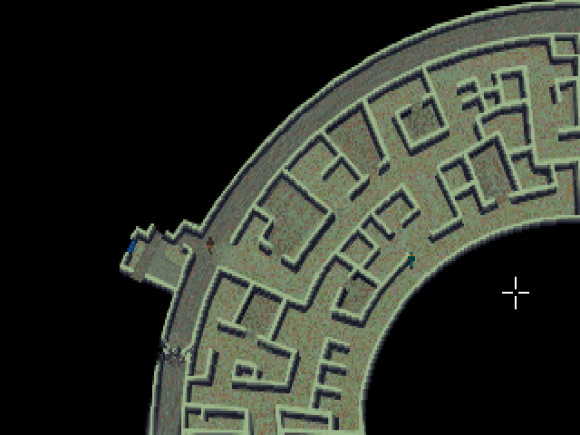
Finally, once you're through the maze and the canals and the backtracking and you've turned on the digging automobile, it bursts through a series of walls to reveal… some other maze, this one of the screens-with-multiple-connected-exits variety. I had to quit the game for a few hours at this bespeak, despite knowing that I was very close to the end of the game, because I couldn't bear the thought of going through the tertiary successive maze. Fate Of Atlantis had several of these moments; one thing information technology likes to practise is throw Indy into a dark room and make him blunder around in the dark trying to find the lite switch. On the plus side these scenes have significantly more than attempt put into them than Zak McKracken did, as Indy'south eyes slowly adjust to the nighttime over fourth dimension and he can start to make out the general shape of objects so that he tin can interact with them. Objects in the room don't accept specific names while it's nighttime because Indy can't run into what they are; they're just referred to as "wood thing" and "rock thing", and he has to go upwards shut and touch them before he gets a detailed description. However, what makes them then much worse than Zak McKracken is that turning on the light is no longer a process of finding the lite switch and turning it on, but is instead a multi-step procedure of refueling a generator with fuel siphoned from the truck exterior, or putting down a ladder so that you tin can reach a statue that you lot have to insert a magic dewdrop into, and having to practice all of this in the nighttime is incredibly obnoxious as it involves several separate stages of sweeping the room with the mouse cursor to try and discover the interactable objects (equally if I weren't doing that enough in this game already) and then figuring out what social club to use them in.
And and then in that location'due south some examples of Adventure Game Logic in here that I tin can only describe every bit spectacular. Early on Indy is faced with a coal chute that he cannot climb up because it'southward also glace. His solution to this problem is what whatever of the states would practice when faced with the same state of affairs: become some chewing gum that was stuck to one of the desks upstairs and stick it to his shoes to provide traction, as it's well-known that the adhesive strength of chewing gum is more enough to support the weight of a total-grown man. Soon subsequently, in Tikal, Indy picks upwardly a kerosene lamp and takes it inside a pyramid. At present, if yous or I were to put a kerosene lamp into an adventure game, it would probably be for the purposes of "making lite", or possibly "making burn" equally a secondary option. Fate Of Atlantis instead elects to use the kerosene within the kerosene lamp as a solvent to clear abroad the dirt around some of the engravings in the pyramid, because that'due south plain the showtime thing that comes into anybody's heads when they remember of a kerosene lamp. Indy has to dig holes at several points in the game, and the thing he uses to do it isn't a shovel, merely an ancient ship rib (i.due east. a stick) that he finds on a table in Algiers. In Atlantis he has to distract an octopus before he tin can traverse the canals, so he has to become dorsum into the maze, pick up a specific human being ribcage — there are bones everywhere in Atlantis, but only this ribcage will practise — combine information technology with a sandwich he picked up on a Nazi U-boat, and so chuck the whole thing into a pool full of venereal. This is plainly a foolproof method of catching one, which he can and then employ to placate the octopus.
God, but reading some of the solutions in the walkthrough made me angry. (And yeah, I resorted to a walkthrough halfway through Crete because I couldn't stand the game'southward magical thinking any more; looking back on information technology I'm amazed I made information technology that far before not bad.) Indiana Jones And The Fate Of Atlantis might have multiple routes through the game, but later beingness bored to tears past the Teamwork route I was in absolutely no mood to try either of the others; the boxing minigame is much harder this fourth dimension around, and you absolutely cannot convince me the absurd puzzles would be improved by making them more complex on the Wits path — and anyway, they both end in the aforementioned ho-hum trek around the Atlantis mazes. After hearing so much about the game'southward quality — both in contemporary gaming media and by starry-eyed fans for decades afterward — and after how promisingTerminal Cause turned out to exist, it'due south dreadfully disappointing thatFate Of Atlantis has seemingly learned nothing from LucasArts' subsequent efforts and ends up feeling like null more than a deliberate throwback to the Bad Old Days, and a expert reminder of how far gamble games have come since and so.
andresenalwougausn.blogspot.com
Source: https://scientificgamer.com/lucasarts-time-machine-indiana-jones-and-the-fate-of-atlantis/

Postar um comentário for "Concept Art Zak Mckracken Map Indiana Jonesfate of Atlantis"